
::HOME | All Things Zum HOME | Submit Zim Zum News | Help Promote Zim Zum::
::Z2 Articles & Interviews | Z2 Reviews | Z2 Transcripts::
::Black Hearts Bar & Grill::
You recently released four new tracks including Nothing Compares to the Magnitude of a Wasted Life. Is that a relatively new song, or has it been in the works for a long time? So, there has obviously been a lot going on behind the scenes over the last year. You were talking about the writing that you’ve done over the past year. As you’re rewriting, are you re-recording along the way? When you’re recording different guitar parts on the same song, are you ever knowingly doing something on the recording that you know you’ll never be able to do live? It seems to be a Catch-22. You focus on TPCS as a live band a lot. At the same time, you’ve got a really big, complex sound, so how do you take that to the stage? So you don’t know when you’re starting to write and record whether it’s going to be an instrumental or solo or Pop Culture Suicides song? When you’re recording, you do all the instrumentals. Do you also record a version of every song with you on the lead vocals? You perform Ordinary Life on every live TPCS show, more or less? So did The Pop Culture Suicides pick up Who Will Save Us Now and the rest of the catalog that you had slotted for the old Pleistoscene? The titles of some of the songs that you’re playing now also sound familiar from before The Pop Culture Suicides.
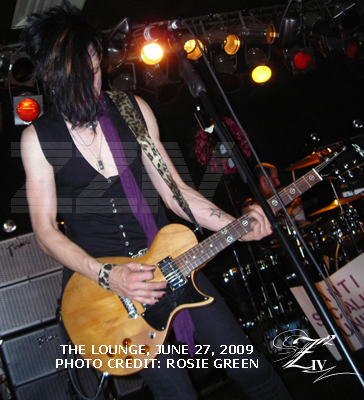
Nothing Compares to the Magnitude of a Wasted Life is at least two years old. It’s just been kind of sitting. Originally, when I thought of releasing it, I was going to have it come out before Personality Crisis even though Personality Crisis is a much older song. The songs on the MySpace page don’t go up in order relative to when they are written. Some of the songs have been sitting around for years. Personality Crisis is probably about ten years old. Inherently Hopeless is one of the newest ones, and it’s still at least a year old. It was written after we played the Pearl Room the last time. I’ve got a lot of songs that are sitting, and I’m patient with some of them because I know they’re probably The Pop Culture Suicides’ kind of songs. For some of them, it’s just a matter of getting vocals on them, mixing them, and taking the time to do that process in between shows or any of the other ten thousand things that can come up. It seems typical of the life of a musician or song writer; it’s something very simple, but life tends to get in the way of a lot of things. For me, if I’m not writing or recording or playing, I don’t feel like I’m contributing or being creative and I go crazy. It’s not good.
With the band, it’s always an extreme labor of love. I like to play live. Sometimes, I forget how much I like to play live. But sometimes, it’s just not high on my priority list because I’m writing a lot and recording a lot. I could go either way. I get into these modes where I can write for sixteen hours a day for a week. Inherently Hopeless, Not Today and a song called, You Wouldn't Even Last a Minute, were written when I was writing and recording three songs at the same time. I would go back and forth between the songs on the same day as an experiment to see if I can write three independently creative songs but have them be nothing like each other. Working on one song for a week solid and then moving on to the next song works for me. I can work that that way most of the time. I just do it as it comes. I might not write for a month, and then, all of a sudden, there are three or four new songs. But writing while juggling three songs at the same time was the last weird experiment that I did.
The band is always an evolution. For whatever reason, I tend to get singled out as this person who is a dictator and tears through band members, but it’s not really that. It evolves; it changes, and sometimes it’s dumb and it’s just about the caliber of adult interaction. Sometimes it’s dumb, but it’s like when you’re driving the car with the window down and you don’t even recognize it anymore; it’s just there. It’s part of my search to find this ideal picture of the people that are in the band. It’s the ideal and the evolution at the same time. So it does change, but right now, it’s probably the closest it’s ever been. I’m not sitting down thinking, “What am I going to do about this guy?” It’s good. It’s comfortable. The rhythm section as a whole is a true musical rhythm section: a drummer’s drummer and a bass player’s bass player. For me, Cornelius has always been that kind of bass player. From the first day I started playing guitar, my best friend got a bass, and he evolved into this ridiculous, ridiculous bass player. For me, it’s like when you compare all the girlfriends you have to the first girlfriend you had. There’s just this ideal that seems to work. With his playing upright bass and just really being musical, I think the level of musicianship with Cornelius being in the band is very good right now. I think that anyone who’s seeing it or hearing it will figure it out right away that I finally got it right.
Many painters never really consider their paintings “done.” They are always adding or something, so if you come back after six months, you’ll find that a painting which you though was complete has changed. Are you the same way, or do you reach a definitive point of completion on your songs?
Any time that I ever use the word “finished” or “done,” I jinx myself and it’s guaranteed that I’ll go back and I’ll change something. Still, I’m not one, who ever feels that I have to close the door. There are songs that I’ve released which we play differently live. There are alternate recorded versions of them, too. So, I’m okay with tweaking it. With some songs, I’m also okay with feeling like they’re done. I get this vibe that there’s nothing more I should do to it, so I just leave it alone. Not Today is a perfect example. There’s a bunch of songs like Ordinary Life and Apocalyptic Love Song that are based on very vivid experiences, but I listen to them the same as anyone else does. It kind of makes me laugh when I listen to them because I’m not afraid to just be a fan of the music too. Some of these songs come so fast. Who am I to say that it’s not a weird channeling experience? I don’t know where I’d be channeling it from… maybe my psyche. Maybe I’m channeling it from things that are going on in my head rather than channeling it from some cloud. But I listen to songs like Apocalyptic Love Song, Ordinary Life, Can’t Ignore The Noise… I could list a bunch of them, and they just feel complete to me. It feels done and I don’t have to play with them. Personality Crisis is a song that’s been around for a long time, and I’ve tweaked it recently. I added some parts to it, changed things around a little bit, added a harmony to the vocals, and that just came out of playing it live. It’s in the moment. Weird things happen; I hear notes that heterodyne and a combination of things sounds like something else to me, and it just kind of works, so I go home and I try it out.
Sometimes, I have gone back and changed guitar tones so it’s bigger, better… now. My evolution of guitar tone as applied to song writing is probably the exact opposite of what most people would think. A lot of people think, “I really like your tone” or “I really like this tone you used on Antichrist Superstar or Mechanical Animals or Ordinary Life.” To me, it’s always been guitar, guitar cord, and amp, and then everything else is based on the way you play. I’m not a big distortion guy. I’m not a big fuzz guy. I would have to say I’m more of a gain guy… gain and EQ. I’m really a tone chaser kind of guy. When going through to tweak it, I’ve stripped it down. It’s always been very minimalist. I have never used a lot of effect unless it’s blatant and I’m doing it to prove a point in the song or create some different atmosphere. So I go back, and I tend to un-heavy the guitars using different textures of guitars. To me, it’s updating it, but it’s really just making it a little cleaner and thicker. There are songs where I’m making a statement, whether it’s heavy or it’s completely un-heavy. I am equally comfortable with both. Sometimes, I will go back and I’ll tweak a song and change a little tone here and there. Vocally, I might go back in and add something.
On a number of occasions, I have made it extremely difficult for myself. It’s always kind of fun because I’ll laugh after the fact. “What the fuck was I thinking? Yeah, that sounds great, but now what am I going to do with that?” So far, I don’t think I’ve run into not being able to do it. Now, that means I’ve spent a week in a rehearsal studio turning knobs and adjusting effects and routing MIDI. So far, so good. There are a couple things that were tricky. I would say the most difficult thing for me playing live is the dance that I have to do with the technology. To go into random environments and be able to have at least some sense of control over my tone when dealing with sound guys, monitor guys, weird rooms, a sound at sound check and a sound when the room is full… Being able to adapt to that is something I keep it in mind when I’m writing, especially if I’m going extreme with something. There are some songs that I’ve never even really thought about playing live. When I’m actually recording the song, if I think, “How am I ever going to play this song live,” I don’t. Inherently Hopeless was a song that I never thought we would play live, but we did. There are a lot of songs that come out of nowhere. I’ll finish recording one and think that it’s going to be one of those songs that it doesn’t fit in any of the categories, so it will probably end up just being me.
No, and it can go in any direction. There are songs where the recorded version has only my vocals on it, but we’ve played them live.
I do at times to guide tracks and to speed the process along. It depends on how impatient I am with getting the song done and how much I want to just to sit back and hear it. There’s a certain part of the process that I’m just not a big fan of. Having Finn come in and track vocals is the producer part of me, and that’s not always my favorite thing to do. I’m super, super fast and there’s a reason why it’s just me almost 99.9% of the time. I will grab a bass, hit the keyboard, play the bass part through maybe five times until I have a couple different feels to play with, stop, put the bass away, grab the guitar, hit record, do that, hit record again on another track, and lay down a couple different melody lines. That’s another thing that I’ll do; I will put in guitar melody lines. You can hear it in some of the songs. In some of the verse parts of Apocalyptic Love Song, there’s a lead guitar that’s almost identical to the vocal line. I’ll write the entire song and at some point when I am writing lyrics, I’ll actually voice out the vocal line with the guitar lead. Sometimes it stays on the track, and sometimes it doesn’t. It depends on how difficult the rhythm guitar is as opposed to the lead guitar over it, or if the bottom drops out of the song when we play it live, I’ll tweak it here and there. But I can’t think of ever starting to record a song and thinking, “This is going to be Pleistoscene” or “This is going to be me” or “I think this song fits my vocals” or “This song is without a doubt The Pop Culture Suicides.” No, never. There are some songs that don’t fall into any of those.
Yeah, more or less. We moved it. It’s actually moved up earlier into the set. I never consciously think that there are people that know that song. The free Pleistoscene downloads were so far back before all of this MP3, free album, anti-record-label stuff; I didn’t even think about it at the time. I just put it up and gave it away.
Possibly. Who Will Save Us Now has always been one that we played around with. Everyone in the band has heard it. I don’t know. It’s just never actually made its way in. It could. I don’t know how many people would recognize it now; not that it’s different, but there is an updated version of Who Will Save Us Now. There are a few other ones that date back to that timeframe that could work their way into the set too.
There were a couple different periods of ridiculous writing blocks that I went through. The original one that really exploded included Disillusioned Revolution, Who Will Save Us Now, Ordinary Life, and a bunch of other songs that are distinctly from that time. They were all recorded in this little tiny apartment that I had when I first moved back to Chicago from L.A. There was only enough room for the recording gear, my guitars, and two seats. One at the control and monitor area, and one other one, and that was it. There was no room for anything. I literally remember sitting in that room for weeks alone and doing nothing but recording all those songs.